Enterprise Case (Bicheal Jackson)
Business Strategy · Market Growth · Leadership · Commercial Decision-Making
A simulated SME bicycle company scaled through customer-centred innovation, disciplined reinvestment, automation and responsive market strategy.
Final Business Outcome
£15.8M Company Valuation
Built through eight simulated years of trading, production, hiring, financing, product development and marketing decisions.
89% Market Share
93% Efficiency
88% Sustainability
Background
The challenge was to grow fast without losing control.
The simulation placed our team inside a competitive SME environment where every decision affected cash, capacity, demand, staff morale and long-term company value.
Context
Bicheal Jackson was a simulated bicycle SME competing in a dynamic market across eight trading years.
Project
Growth required more than sales. We had to balance finance, production, marketing, R&D, people and operational efficiency.
Opportunity
By reinvesting early profits into automation, research and product development, the company could scale while retaining strategic control.
My Role
I led team alignment, strategic judgement, and leadership culture while translating eight years of simulation data into a clear shareholder narrative. I kept the team focused on a shared vision through pressure, disagreement, and changing market conditions.
Analyse
Tracked company value, cash, market share, production efficiency, net profit, staff capacity and customer demand.
Decide
Made director-level decisions across pricing, automation, hiring, wages, marketing, sales channels, R&D and finance.
Adapt
Responded to competitor movement and changing market conditions without abandoning the core growth strategy.
Communicate
Converted simulation performance into a clear report showing decisions, evidence, results and leadership reflection.
Company Process
The process combined simulation decisions with reflective business analysis.
We had to make live strategic decisions, interpret performance data and then explain the logic behind our outcomes in a professional shareholder report.
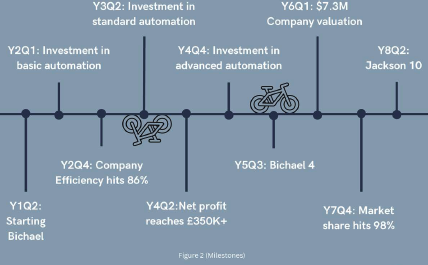
Company Achievement Timeline
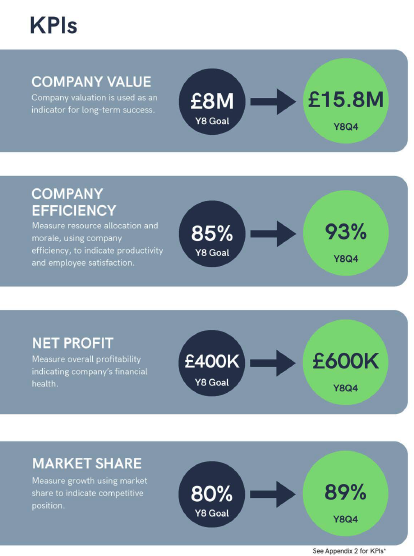
Company KPIs
Business Strategy Response
The strongest performance came from connected decisions, not isolated wins.
The project showed that SME strategy works best when finance, operations, product, people and marketing reinforce one another.
Business finding - Automation
Automation became the main scaling lever because labour alone could not support long-term output growth.
Strategic response
We reinvested into basic, standard and advanced automation to improve production speed and margin control.
Business finding - Alignment
Leadership alignment mattered when the team faced performance pressure and disagreement.
Strategic response
As CEO, I focused on keeping the team confident, aligned and committed to a shared long-term strategy.
Business finding - Market Share
Market share growth only mattered because the company also protected efficiency, cash and production capacity.
Strategic response
We treated growth as a system, linking sales ambition to automation, staffing, pricing and financial resilience.
Business finding - Customer-Centric R&D
Customer-centred R&D helped the company compete through quality and product relevance, not only price.
Strategic response
We used market research and product development to improve fit with commuter needs and strengthen the product portfolio.
Impact
The strategy improved performance across growth, operations and resilience.
The business outcome was not just a higher company valuation. It showed stronger efficiency, better market position, healthier profitability and improved sustainability.
Growth
Built a company worth £15.8M and achieved 89% market share by the final year.
Operations
Reached 93% efficiency through automation, capacity planning and better production decisions.
Resilience
Protected 100% founder equity and ended with strong cash reserves while scaling the company.
Learning & Skills
The project strengthened my commercial and strategic judgement.
Enterprise Case helped me understand how strategy becomes operational through finance, people, production, innovation and market positioning.
Business communication
Turning data-heavy simulation outcomes into a professional shareholder report.
Leadership
Building team alignment, confidence and shared ownership under pressure.
Financial literacy
Understanding how loans, profit, reinvestment, margins, cash and equity shape growth choices.
Commercial judgement
Balancing pricing, market share, promotion, product quality, cash and long-term valuation.
Operational thinking
Connecting automation, staffing, production time and capacity to business performance.
Strategic synthesis
Condensing eight simulated years of trading into a clear business narrative with evidence and outcomes.